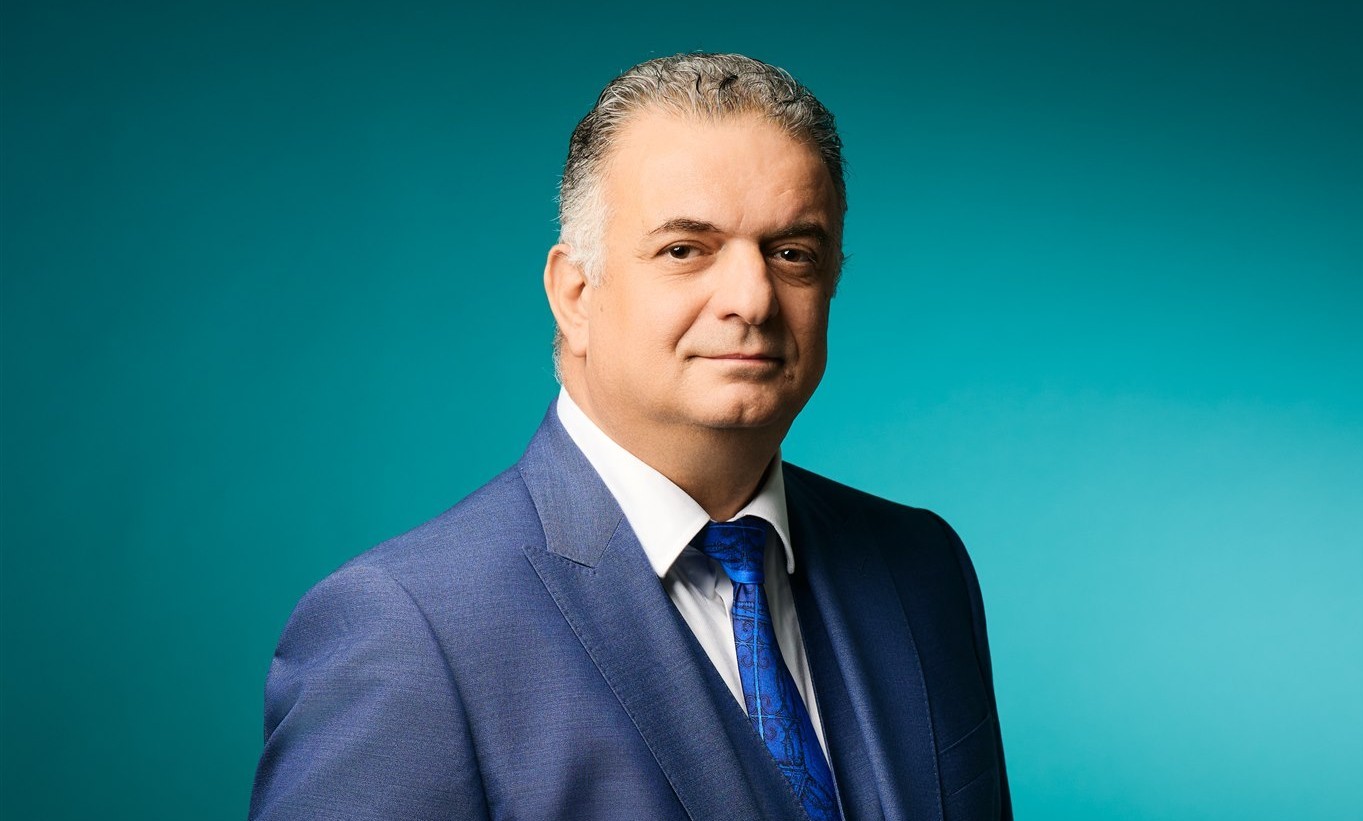
The President of CITEA and Founder & CEO of Powersoft speaks to INK about AI, the changes coming to businesses, the need to start with real business challenges, and Cyprus’s major challenge in the age of Artificial Intelligence.
George Malekkos emphasizes that Artificial Intelligence should focus on solving real business problems rather than on technological impressiveness.The next stage for businesses requires the integration of AI agents into everyday operations, based on the right data and processes.
As CEO of Powersoft, he is committed to the continuous modernization of its products, promoting solutions based on data, automation, and intelligent software.
As President of CITEA, he highlights the need for meaningful investment, education, and closer cooperation between the government and the technology industry.
Adopting the title “AI-Driven Business Transformation Architect,” he designs tailored solutions that transform businesses, placing their real needs at the center.
Artificial Intelligence is changing at unprecedented speed the way businesses operate, products are designed, and decisions are made.
For George Malekkos, however, the discussion around AI needs to move beyond the excitement surrounding the technology and into the real economy.
With more than 30 years of experience in business software, cloud computing, retail technology, and digital transformation, he has witnessed numerous technological changes. Today, his focus is on the practical application of AI within businesses and on how AI agents, automation, data, and intelligent software can create real business value.
George Malekkos is President of the Cyprus Information Technology Enterprises Association (CITEA) and Founder and CEO of POWERSOFT Computer Solutions Ltd, which he founded in 1993. Through Powersoft, he leads the development of ERP, retail, and fashion technology solutions, as well as a new generation of AI-powered applications that combine business data, automation, and intelligent agents.
At the same time, he has been active for many years in education, business innovation, and Cyprus’s technology ecosystem as a keynote speaker, trainer, mentor, and judge at international innovation institutions. Speaking to INK, George Malekkos explains how Artificial Intelligence is redefining business, highlighting the need to move from simple IT projects to meaningful business transformation focused on solving real problems.
What do you believe will be the biggest change in businesses over the next 3 to 5 years?
I don’t believe the biggest change will simply be the use of more AI tools. It will be a change in the way businesses themselves operate.Today, we mainly use AI to help us write, analyze, or find information. The next stage is for AI agents to become part of a company’s everyday operations.
Technology on its own is not a strategy
One agent will monitor sales, another stock, another customers, and another marketing. They will identify problems, recommend actions, and, in certain cases, be able to execute tasks. That is why I keep saying that we should not see AI as just another IT project. We must first identify the business pain point and then see how AI can solve it. Technology on its own is not a strategy.
After more than 30 years in technology, what keeps Powersoft innovating?
I think it is our obsession with the customer’s problem.
I don’t usually start with the question, “What new technology can we use?”
I start with, “What is hurting you today?”
What is costing you time? Where are you losing money? What can’t you control? What is frustrating your customer? Which decisions are you making without enough data?
If we identify the real pain point, then we can put ERP, data, automation, AI, or whatever else is needed behind it.
I don’t just want to show you what AI can do. I want to show you what it can solve for you.
In the past, I really enjoyed creating an impressive demo. And I still enjoy seeing new technology work.
Today, however, I am much more interested in the solution. Maybe I have matured, or perhaps our solutions have matured as well. If I now do a demo, I want to do it using your data, your real problem, and your business.
I don’t just want to show you what AI can do. I want to show you what it can solve for you. For me, that is real innovation.
What is the greatest responsibility you feel today as a CEO?
Not allowing a company with a history dating back to 1993 to operate with the mindset of 1993. That is perhaps one of the most difficult things for any entrepreneur.
The more successful something was in the past, the easier it is to try to protect it. I prefer to challenge it.
I want our products to be able to evolve continuously, to be API-first, cloud-first, and now AI-driven. And I want our people to evolve alongside the technology.
For me, success is not simply about more sales. It is about creating today the company that will be able to compete in a world that, three years from now, will be very different from today.
What is the biggest mistake you see businesses making today when it comes to AI?
Starting with the tool.
“I want ChatGPT.”
“I want a chatbot.”
“I want AI.”
My first question is: Why? What do you want to fix?
We need to start with the business process and the outcome we want to achieve.
Without the right data, processes, and human responsibility, even the best AI in the world can produce the wrong result faster.
Do you want to increase sales? Reduce stock? Forecast demand more accurately? Serve customers faster? Reduce repetitive work? Provide management with better information?
Then we can design the AI around that.
There is also something else that is extremely important: data.
Without the right data, processes, and human responsibility, even the best AI in the world can produce the wrong result faster.
How do you manage the pressure of being a CEO, President of CITEA, trainer, and constantly working on new projects?
I am probably not the best example of someone who will tell you that they have a perfect work-life balance.
I really enjoy what I do, and my mind is constantly working on new ideas. I might be on a plane, in a shop, at a restaurant, or on a trip and see something that makes me think of a new product or a new solution.
However, I try to use a simple filter:
Can we do it?
Does it solve a real problem?
Can it create real value?
If the answer is yes, then the discussion begins.
And there is also something more personal. I strongly believe in the “collection of memories.”
Businesses, travel, the people we meet, successes, and even failures are all part of this collection.
As President of CITEA, what do you consider to be the biggest challenge today?
I’ll be honest. When I took over the Presidency of CITEA, the job turned out to be much more demanding than I expected.
And the reason is simple: we have a lot to do.
For several years, CITEA could have played a much more active role in issues affecting our industry. And I include myself in this criticism. I was on the Board for years and served as Vice President, so I also have my own responsibility.
Today, however, things are changing so quickly, especially with AI, that we cannot afford to simply be observers.
CITEA needs to be much more active. It needs to have a voice, intervene, propose solutions, apply pressure when necessary, and above all, genuinely represent Cyprus’s technology companies.
The work ahead of us is enormous: AI, digital transformation, skills, cybersecurity, public procurement, funding, international expansion, industry development, and much greater cooperation with the government.
What I want is for us, at the end of this period, to be able to say that CITEA has genuinely become part of the decision-making process that affects the country’s technology industry.
And specifically regarding AI, what does Cyprus need to do?
We need to move from strategies to implementation. Cyprus has people, technology companies, universities, researchers, and a business environment that allows us to move quickly.
With AI, however, speed is critical. We need meaningful investment, skilling and upskilling, better access to AI for SMEs, fast funding tools, and specific KPIs so that we can know whether what we are doing is actually producing results.
We also need much stronger cooperation between the government and industry. I would also like to see more Cypriot companies creating IP, developing their own AI products, and exporting them. Cyprus is a small market. That can be an advantage. We can test quickly, make corrections quickly, and then go international.
Ultimately, what does “AI-Driven Business Transformation Architect” mean to you?
I created the title “AI-Driven Business Transformation Architect” myself because I could not find an existing title that truly described what I do today.
The word “Architect” was not chosen randomly. My sister was an architect, and that influenced me from an early age. That is why I previously used the title “Software Innovation Architect.”
I lost my sister two years ago and, in a way, by keeping the word “Architect” in my title, I also keep a part of her with me. Today, my role has evolved. I am not only involved in software or innovation. I try to understand how a business operates, where it hurts, and where it loses time, money, or opportunities, and then design the right solution using ERP, automation, data, cloud, and AI. That is why the title evolved from Software Innovation Architect to AI-Driven Business Transformation Architect. For me, “Architect” means that I do not start with the tool. I start with the problem and design the solution.
Source: Γιώργος Μαλέκκος: «Το AI δεν είναι ακόμη ένα IT project — είναι επιχειρηματικός μετασχηματισμός» – ink