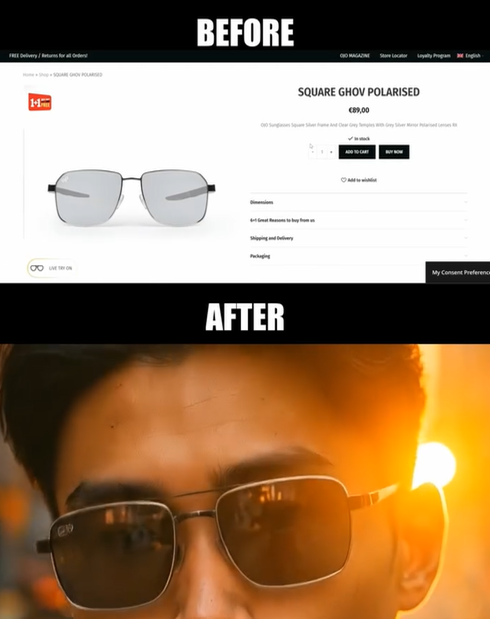
Something weird — and very cool — is happening with UGC avatars, and I have to talk about it.
A few days ago we ran a test: we had digital characters “wear” clothes from Mindy Fashion and glasses from OJO.
For the Mindy clothes, we picked a model who was actually wearing them and told the tool to “bring her to life and have her talk to us about the product.”
For the OJO glasses, we picked a non-existent model to wear them…
I wasn’t expecting much… but when I saw the result, I froze — in the video I literally said “my head flew off.”
Honestly, if you don’t know it’s an avatar, there is no way you’d guess it isn’t a real person.
And yes, I know, it sounds like another AI hype moment. But nope — this is genuinely something that changes the game for retail brands that struggle with budgets and content production.
Think about it simply:
No model needed.
No photoshoot.
No coordinating ten different people.
You open the tool → “dress” the character → you have content.
As much as you want. Whenever you want.
I’m not saying it’s perfect. It has its quirks (I’ll write about those in another post). But the ability to produce content this fast and this cheaply… is a serious advantage.
UGC Avatars: The Less Glamorous, More Real Side
What are we actually doing?
I see posts everywhere about digital twins, virtual influencers, and all kinds of futuristic stuff. In reality, what UGC avatars do is simpler — and maybe more useful than what the hype is selling.
We take products (clothes, accessories, whatever you want)
→ We put them on an avatar
→ The avatar poses in photos and videos like a real human.
The character doesn’t exist. But the result does — and it’s fully usable for real commercial content.
Why do we even do this?
Because a photoshoot… costs money. And takes time.
Models, studio, photographer, styling, post-production — and all that just for one series of photos.
With avatars though:
• You create them once
• Then you just change their outfit
• And you can play around with backgrounds, poses, lighting
• As much as you want
Honestly, if someone had told me this a few years ago (and I’m a super tech guy), I would have laughed. Now we actually use it.
The Mindy Fashion & OJO example
When we did the demo, we had brands with completely different products.
We put the clothes and the glasses on the avatars, and the result was cleaner than many real photoshoots. The texture, the shadows, the way the clothes “sit”… everything looked legit.
Yes, if you zoom in and look for flaws, you’ll find something off.
But for social, ads, product pages? It’s more than enough.
What’s actually changing?
1. Unlimited content — sky is the limit
You no longer need to optimize 10 photos because “that’s all the budget allows.”
You can make as many as you want, whenever you want.
2. A/B testing becomes effortless
Urban background or studio look?
Warm light or cool light?
Same outfit on different body types?
Try everything. Production takes minutes.
3. Consistent branding
With real photoshoots, something always changes — the light, the mood, the model’s skin tone, the overall vibe.
With avatars, you can keep the same aesthetic across 200 photos.
The downsides — because yes, they exist
The main ones:
• It doesn’t have the emotional impact a real person gives
• Some fabrics/prints still “challenge” the tech
• It needs some setup before it looks the way you want
• Some users may see it and say “meh, this isn’t real”
There’s also the transparency question:
Should you say you’re using avatars?
Personally, I think yes. Always.
Where are we heading?
The tech levels up every month. Soon you won’t even know if what you’re seeing is an avatar or not.
For brands, this means:
• They can showcase collections before they even launch
• Content becomes part of the product cycle
• Try-on will become everyday behavior
• And content production… just upgrades to another level
Those who start early will gain time, experience, and visibility.
Final thought
UGC avatars aren’t the future. They’re already here.
They won’t replace humans — nor should they.
But as a tool to take your content three levels higher without blowing up your budget?
Yes, it’s a big deal.
Source∶https://www.instagram.com/p/DRR3SUYjKua/